Currency, both for VFR and IFR operations, is a frequently misunderstood and confusing topic.
Here is a reasoned summary of the requirements you must satisfy before flying, with or without passengers, under VFR or IFR rules, day or night.
Day Passenger-Carrying Currency
In order for you to act as PIC today while carrying passengers, you need to have performed 3 take-offs and 3 landings within the 90 calendar days preceding today (or today).
You must have been the sole manipulator of the controls during those takeoffs and landings, and you must have performed them in the same category, class and type (if a type rating is needed in the plane you want to fly today).
These requirement are stated in 14 CFR 61.57(a).
When don’t need to satisfy passenger currency requirements? […]
Of course you don’t need to satisfy passenger-carrying currency if you intend to fly with no other occupants in the plane.
You also don’t need to satisfy PIC passenger-carrying requirements if you will not be acting PIC. That is possible only if you fly with another pilot who will be acting PIC, and qualified and current for that.
You also don’t need to be passenger-current when receiving instruction from a CFI for the purposes of regaining currency.

Acting PIC vs Logging PIC time
Remember that there is a distinction between acting PIC and logging PIC time:
- The pilot who is acting PIC must have a valid medical, be appropriately rated and/or endorsed. The pilot acting PIC is legally responsible for the outcome of the flight.
- The same pilot or a different pilot might log PIC time: that pilot must be the sole manipulator of the controls during the time logged as PIC. The pilot logging PIC time is not required to be fully rated or endorsed, if an endorsement (e.g., high performance) is needed to act as PIC in that aircraft. The pilot logging PIC time is also not required to satisfy passenger-carrying currency.
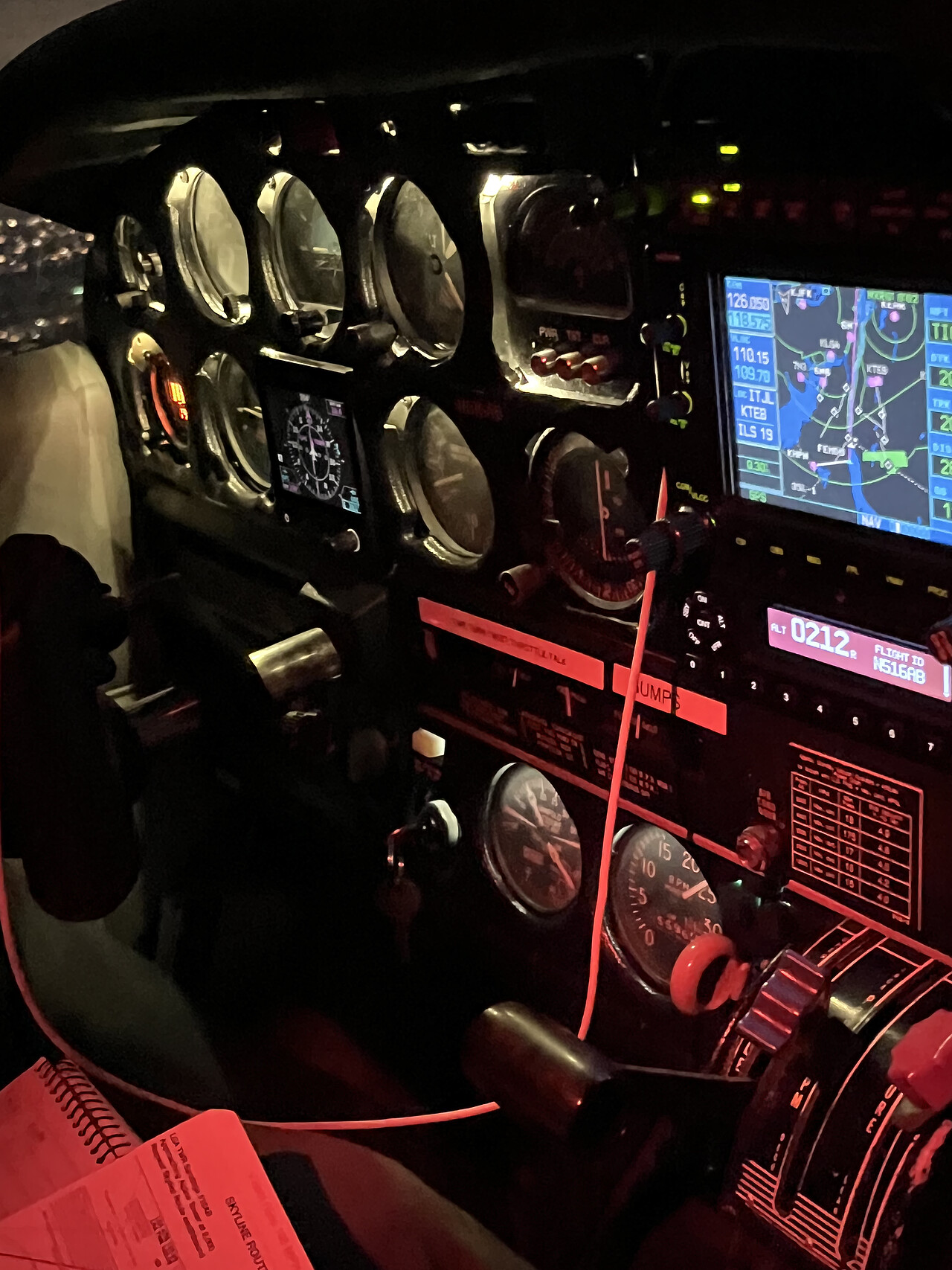
Use an almanac to determine sunset/sunrise today at your longitude/latitude, for example: https://www.timeanddate.com/sun/usa/new-york.
If you need to regain night passenger currency, schedule your practice flight so that you take at least one hour after sunset.
Night Passenger-Carrying Currency
In addition to the requirements described above, if you are flying at night, you are subject to 14 CFR 61.57(b), which stipulates that, in order to act as PIC at night, you need to have performed 3 takeoffs and 3 landing within the last 90 days at night.
And additional requirement for landings performed for night currency is that they must be done to a full stop.
Pay attention to the definition of night relevant for the purposes of passenger-carrying currency […]
The definition of night contained in 61.57(b), which differs from two other definitions of night found in the regulations (i.e., night for the purpose of operating airplane lights, and for the purpose of logging night flight time).
For the purposes of determining passenger-carrying currency, night is “the period beginning 1 hour after sunset and ending 1 hour before sunrise”.
You don’t strictly need night passenger-carrying currency if your flight lands after sunset but within 1 hour after sunset … but of course it’s a good idea to have night currency anyway.
Flying with a CFI while not Passenger-Current
Pilots are frequently confused on whether they can carry an instructor in their plane, for the purposes of receiving flight instruction, if they are not passenger-carrying current.
The answer is YES, you can, if any of the two following conditions are satisfied:
- you are receiving flight instruction to regain currency, or
- your CFI is agreeing to act as as PIC for this flight.
Condition (2) is self-explanatory: if your CFI is acting PIC, you don’t have to satisfy PIC requirements –including passenger-carrying ones.
If your CFI does not agree to act as PIC, and you will be acting PIC, condition (1) acts in your favor, saying that you are exempt from having to satisfy passenger-carrying currency as long as the instruction you receive from your CFI is intended to meet passenger-carrying currency.
You should plan activities in your instructional flight so as to practice take-offs and landings first. That way, you are covered by condition (1) while not current, then you become current, then you perform the rest of the instructional flight while passenger-carrying current.
The exception to the passenger-carrying requirements that allows you to receive flight instruction without passenger currency is today codified by 14 CFR 61.57(e)(5) […]
(5) Paragraphs (a) and (b) of this section do not apply to a person receiving flight training from an authorized instructor, provided:
(i) The flight training is limited to the purpose of meeting the requirements of paragraphs (a) and (b) of this section;
(ii) Notwithstanding the provisions of paragraphs (a) and (b) of this section, the person receiving flight training meets all other requirements to act as pilot in command of the aircraft; and
(iii) The authorized instructor and the person receiving flight training are the sole occupants of the aircraft.
Prior to the last changes to 61.57, this exception was covered by the now-rescinded Kortokrax letter of legal interpretation, discussed in depth on the Letters of Interpretation page.
IFR Currency
To act as PIC under IFR rules or in weather below VFR minimums you must have performed the prescribed tasks in the last six months:
- at least 6 instrument approaches
- holding procedures
- intercepting and tracking electronic courses.
These requirements are stated in 14 CFR 61.57(c).
On how exactly to compute the six calendar months […]
The law says that if you perform the required activities any day of a given month, you will be current for the rest of the month, plus six more calendar months following that month.
Example: if you perform your activities between February 5 and February 15, you will be current from February 15 through the end of August.
If your instrument currency has elapsed for less than 6 calendar months, you can regain it by flying the prescribed tasks with either a safety pilot or an instructor.
If your instrument currency has elapsed for more than 6 calendar months, you need an Instrument Proficiency Check with a CFII. Email us to schedule one today.
FAQs
Do takeoffs and landings at night also make you passenger-carrying current for the day?
YES. Because of the way 14 CFR 61.65 (a) and (b) are written, if you regain your night passenger-carrying currency, you are also day passenger current.
Remember, however, that there is a difference between currency and proficiency. The law might allow you to fly passengers, but the law doesn’t know how safe will you be doing that.
It is your responsibility to judge your level of proficiency at any given task required for the safe completion of your flight and, when there’s doubt, postpone that flight will you had a chance to practice more or seek instruction.
When in doubt, it’s always a good idea to schedule time with a CFI. An external, objective observer like a CFI is your only protection against blind spots and standards degradation, i.e., you think you are proficient according to standards that you think are adequate, but it’s been too long since you last verified your standards against an objective source, and they have slipped.
Does my CFI need to be passenger-carrying current while instructing me?
It depends on whether the CFI will be acting PIC.
- If the pilot receiving instruction is otherwise able to act as PIC for that flight (but not passenger-carrying current), 14 CFR 61.57(e)(5) allows them to act as PIC with their CFI on board even if not passenger-carrying current.
The pilot and their CFI must agree ahead of the flight that the first and not the latter will be acting PIC. - If the pilot receiving instruction is not legal to, or unwilling to act as PIC, then the CFI must act PIC.
If the CFI acts as PIC, they must be passenger-current in order to perform instruction.
Note that things have changed recently. The Olshock, 2007 Letter of Interpretation used to allow CFIs to instruct without passenger-currency, but that interpretation has been rescinded by NPRM 88 FR 41194.
The now-rescinded interpretation of the law implied that a CFI and a pilot under instruction were not considered passengers to one another. Now they are, and the law codifies exceptions to the pilot’s passenger-carrying requirements when receiving instruction. The law, however, no longer allows the CFI to be not passenger-carrying current when instructing and when acting PIC.
Does my CFI need to be acting PIC while instructing me?
In general, NO.
Any pilot in the plane who is appropriately certified, rated and endorsed (if endorsements are needed) to act as PIC can act as PIC.
Student pilots are, in general, not allowed to be PIC except when flying solo under a solo endorsements.
(And, of course, they will have no other occupants on board, and that means nobody else, not even their CFI.)
The term “student pilot” here is technical, meaning “the holder of a student pilot certificate” and not “a pilot under instruction”.
Remember that once you obtain your private pilot certificate, that certificate supersedes the student pilot one, and you are no longer considered a student pilot for the law.
A pilot (not a student pilot) under instruction can, in general, act as PIC if qualified and willing.
In that case, who will be acting PIC must decided ahead of the flight.
If you own your plane and you are able to be PIC, you may want to be acting as PIC.
For example, insurance stipulations may require that you act as PIC while receiving instruction on your plane.
If you receive instruction in a flight school’s plane, school policy might required that the CFI acts as PIC and you, as a customer, are not given the choice to be acting PIC. You certainly have all reasons not to want to act as PIC, as to minimize your responsibilities.
Also, remember that acting PIC and logging PIC time is distinct.
The distinction is covered earlier in this page.
Is there any difference between regaining instrument currency with a CFII vs. with a safety pilot?
Legally, no.
If you complete the activities prescribed in 61.57(c)(1), either with a safety pilot or with a CFII, you regain instrument currency equally.
There is an advantage in flying those tasks with a CFII because the CFII will, in general, be better equipped to teach, critique and help you improve your standards.
Why does the law explicitly require you to “intercepting and tracking courses through the use of navigational electronic systems”, when you are already flying approaches and holds using electronic navigation systems?
Specifically, one may ask what is the point of 14 CFR 61.57(c)(1)(iii), when (i) and (ii) already require flying approaches and holds, presumably with the use of electronic navigation. Indeed, if you fly any ILS, LOC, VOR or RNAV approaches, you are satisfying (iii).
How is it then possible to satisfy (i) without also satisfying (iii)?
The answer is that one could fly solely PAR and ASR approaches (precision and non-precision, radar-based approaches) in which the pilot navigates according to ATC instructions offered on the basis of ATC observing the aircraft course via radar. This is a very uncommon, but possible, scenario.
If you fly 6 radar approaches you are satisfying 14 CFR 61.57(c)(1)(i), but you haven’t exercised any skills necessary to intercept and track electronic courses.
The regulations added (iii) to ensure that, if you want your instrument currency, at some point you exercise electronic course interception and tracking skills.
Can a CFI who is not a CFI-I perform an IPC?
No.
The FAA’s chief legal counsel has expressed in the Griffith, 2008 Letter of Interpretation that an IPC must be performed by a CFII, and it’s not enough to be a CFI.
You can find this LoI in our Letters of Interpretation section.
Can your safety pilot log PIC time?
A safety pilot can log PIC time only if they are also acting PIC.
The legal justification for the safety pilot to be able to log PIC time is 14 CFR 61.51(e)(1)(iii): a pilot can log PIC when acting as PIC during operations on which more than one pilot is required by the regulations (specifically, 14 CFR 91.109(b)).
The safety pilot is required for flight in simulated instrument conditions, so it falls under this provision.
You and your safety pilot must agree ahead of time that he or she will be acting PIC during the flight, and he must be qualified, rated and/or endorsed appropriately to act as PIC in that plane.
If the safety pilot cannot or chooses not to act as PIC, the safety pilot can still log SIC (second in command) time.
This is case is covered by 14 CFR 61.51(f)(2).
The pilot under the hood can log PIC time under the provisions of 14 CFR 61.51(e)(1)(i).
In summary, it is possible for both pilots to log PIC time only when the safety pilot agrees to be PIC.
How should I fly an approach to ensure I can log it for currency?
The requirements for pilots to be able to log instrument approaches for the purposes of currency of experience are discussed in detail in InFO (Information For Operators) 15012.